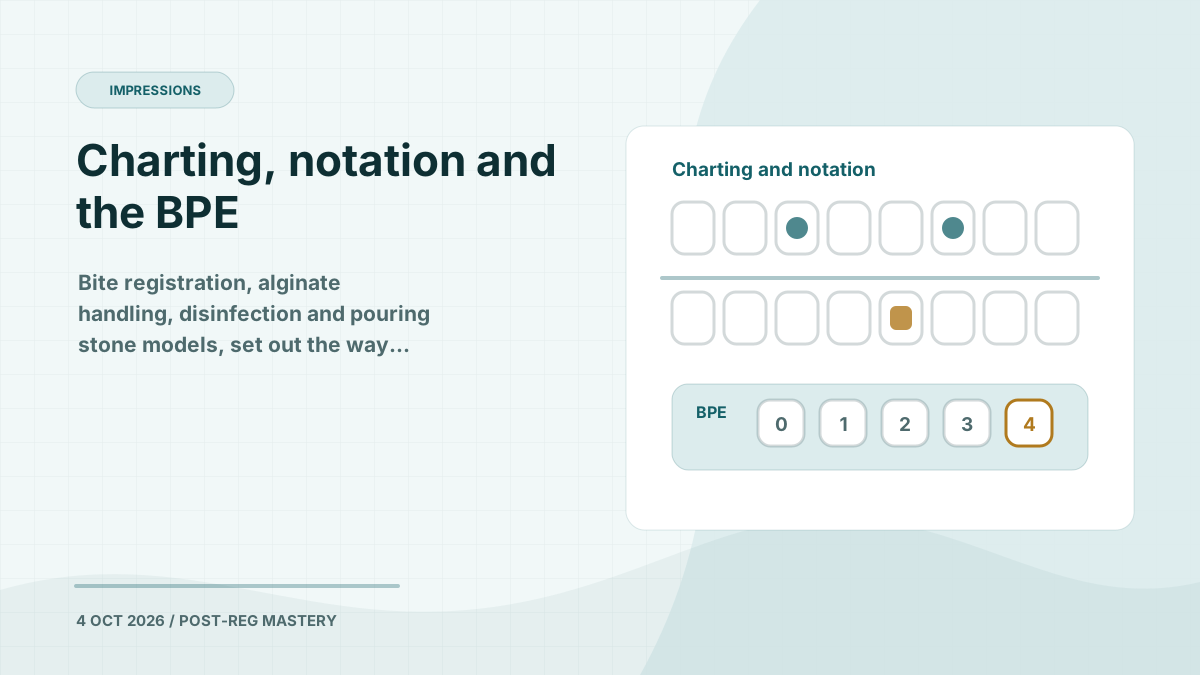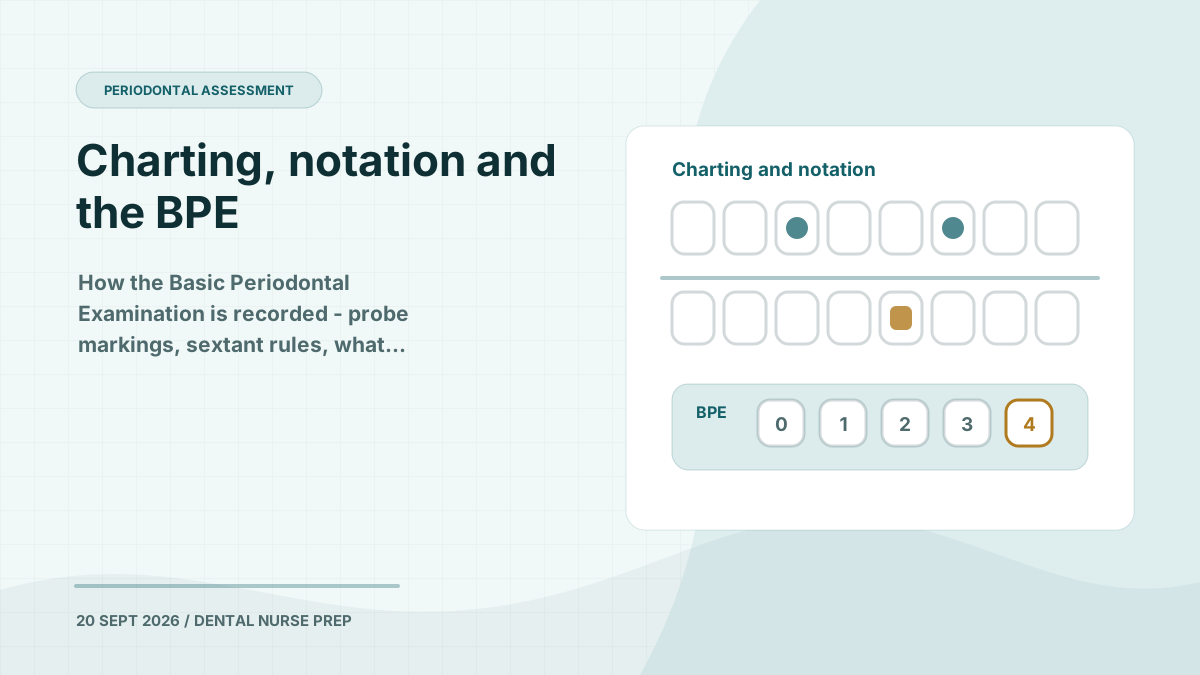

The Basic Periodontal Examination comes up in the exam over and over. That isn’t because you’ll be the one holding the probe. It’s because you’ll be the one recording the result, and recording it correctly means understanding what the clinician is calling out.
As the clinician in the source video puts it:
“It’s not a method of diagnosing but is a method of screening them so that we can provide them with the appropriate periodontal management that they may require.”
Keep that distinction in mind and a whole category of distractors falls away. The BPE is quick, simple and effective, and it is not a diagnosis.
The instrument: the WHO probe
The BPE uses the World Health Organization (WHO) probe. Its markings are what make the whole system work:
- A 0.5 mm ball end at the tip.
- A black band from 3.5 mm to 5.5 mm. This is the one that decides the score.
- On many probes, a second black band from 8.5 mm to 11.5 mm.
The probe is walked around every site on the teeth in a sextant with a light force of about 20 to 25 grams. A common way to judge it is that this is roughly enough pressure to make the skin under your fingernail blanch. Only the worst score in each sextant is recorded.
Dividing the mouth into sextants
The adult mouth is split into six sextants. Using the tooth notation you’ll be recording in:
| Upper arch | Lower arch |
|---|---|
| Upper right 7 to upper right 4 | Lower left 7 to lower left 4 |
| Upper right 3 to upper left 3 | Lower left 3 to lower right 3 |
| Upper left 4 to upper left 7 | Lower right 4 to lower right 7 |
A few rules here are favourites for exam questions:
- Third molars are left out unless the first or second molars are missing.
- A sextant needs at least two teeth to be scored. If there’s only one tooth, it is included with the neighbouring sextant, and the original sextant is recorded as X.
If you’ve charted for a while, the X will be familiar. If you haven’t, it’s easy to mistake it for “missing data”. It isn’t. It means “not enough teeth here to score separately”.
The codes, 0 to 4
The probe band does most of the work. Codes 0, 1 and 2 all have the black band fully visible, so there’s no pocketing. What separates them is what else is found.
| Code | What the clinician finds | Probe band |
|---|---|---|
| 0 | No pocketing, no bleeding, no plaque retentive factors | Fully visible |
| 1 | Bleeding on probing, no pocketing, no plaque retentive factors | Fully visible |
| 2 | Plaque retentive factors such as calculus or overhanging restorations, no pocketing | Fully visible |
| 3 | Pocketing of 3.5 mm to 5.5 mm, with or without bleeding | Partially visible |
| 4 | Pocketing greater than 5.5 mm | Disappears completely |
| * | Furcation involvement, recorded alongside the code | — |
The asterisk catches people out. It goes with a number rather than replacing it, so you might write 3* or 4*. The video explains why it matters in practice. A clinician may find a code 4 early in a sextant, but it’s still worth checking the rest of that sextant, because the 4 alone wouldn’t show furcation involvement elsewhere.
For a more code-by-code breakdown, see BPE codes explained: what 0 to 4 actually mean.
BPE in children
Children are screened differently, and the differences are easy marks if you know them.
- Screening usually starts at age 7.
- Instead of probing every tooth, six index teeth are used: upper right 6, upper right 1, upper left 6, lower left 6, lower left 1 and lower right 6.
- From 7 to 11, only a simplified scale of codes 0, 1 and 2 is used. This avoids recording false pocketing, which is common while teeth are erupting and doesn’t reflect true periodontal disease.
- From 12 upwards, the full range of codes is used.
The reason for the simplified scale is exactly the sort of thing a question will test: why only 0 to 2 in younger children? The answer is false pocketing around erupting teeth.
Why it matters: each score leads to a course of action
The point of the BPE is that the score directs management. Summarising the video, and following the British Society of Periodontology’s approach:
- Code 0. No periodontal treatment needed. Encourage the patient to keep up their current oral hygiene.
- Code 1. Oral hygiene advice, adjusting the patient’s home routine to deal with the bleeding.
- Code 2. Oral hygiene advice plus removing the plaque retentive factors, such as scaling calculus or correcting overhanging restorations.
- Code 3. Initial therapy: oral hygiene advice, risk factor control and professional removal of plaque and calculus. This is followed by reassessment, with more detailed pocket charting of the affected sextant. If the problem persists, the patient is managed as having periodontal disease.
- Code 4. Periodontal disease is assumed, and the patient goes straight to a full periodontal assessment. This includes detailed charting and, where indicated, radiographs.
The video describes reviewing a first-time code 3 at three months. That’s a widely taught interval. The UK reference point is the British Society of Periodontology’s current BPE guidance, which was updated to match the 2017 classification of periodontal diseases. Your practice protocol, based on that guidance, sets the exact reassessment arrangements.
In the exam. If a question gives you a code and asks what happens next, look for the jump between codes. Codes 0 to 2 are about hygiene and plaque retentive factors. Code 3 means initial therapy, then reassessment. Code 4 means a full periodontal assessment. If an option jumps a step, such as a full assessment for a code 1, it’s usually the distractor.
Your role as the dental nurse
The clinician probes and you record. In practice that means:
- Knowing the sextant order so scores go in the right boxes as they’re called out.
- Recording X for a sextant that doesn’t qualify, and adding * next to a code when furcation involvement is called.
- Making sure the BPE is dated and recorded in the patient’s notes, because the score affects recall intervals and treatment planning.
- Preparing the right instrument. Probes are reusable and go through decontamination like any other instrument. The principles are in cleaning, disinfection and sterilisation.
Carrying out the BPE yourself is a clinical assessment and sits outside a dental nurse’s scope of practice unless you have additional training and the role allows it. For the Diploma, what’s expected of you is understanding and accurate recording.
If you’d like the same topic from a different angle, BPE explained: sextants, scores 0 to 4, and what each one commits you to goes into the scoring decisions in more depth.
Nothing on this page is clinical guidance. It’s revision framing for an exam. For practice, work from current British Society of Periodontology guidance, your practice protocol and your own training and supervision.
Revise it properly
The BPE turns up across the Diploma in charting, oral health and periodontal disease questions, and it’s easiest to remember by working through scenarios. Dental Nurse Exam Revision has 620 questions across 10 topics, with 65 free. It’s built to mirror the format of the NEBDN National Diploma in Dental Nursing Knowledge Test, and it’s an independent revision tool, not affiliated with the NEBDN. If you’re also planning the rest of your revision, see how to revise for the NEBDN Knowledge Test.
- Periodontology
- Oral health assessment
- Charting
Frequently asked
Is the BPE a diagnosis of periodontal disease?
No. The Basic Periodontal Examination is a screening tool. It shows which patients need more detailed periodontal assessment and roughly what management is needed. A diagnosis comes from a fuller assessment, including detailed pocket charting and radiographs where needed.
What are the markings on a BPE probe?
The WHO probe has a 0.5 mm ball end and a black band running from 3.5 mm to 5.5 mm. Many probes also have a second band from 8.5 mm to 11.5 mm. How much of the first band you can see decides whether the code is 0 to 2, 3 or 4.
Which teeth are used for a child's BPE?
In children, the six index teeth are the upper right first molar, upper right central incisor, upper left first molar, lower left first molar, lower left central incisor and lower right first molar. BPE screening usually starts at age 7. From 7 to 11 only codes 0, 1 and 2 are used, and from 12 the full range applies.
What does an asterisk mean on a BPE chart?
An asterisk (*) means furcation involvement. It is recorded alongside the code for that sextant, for example 4*, and it flags something that changes how the patient is managed.
Does a dental nurse carry out the BPE?
The clinician carries out the BPE. The dental nurse usually records the scores in the patient's notes as they are called out. For that you need to know the sextant order, what each code means and how an X or an asterisk is written.