
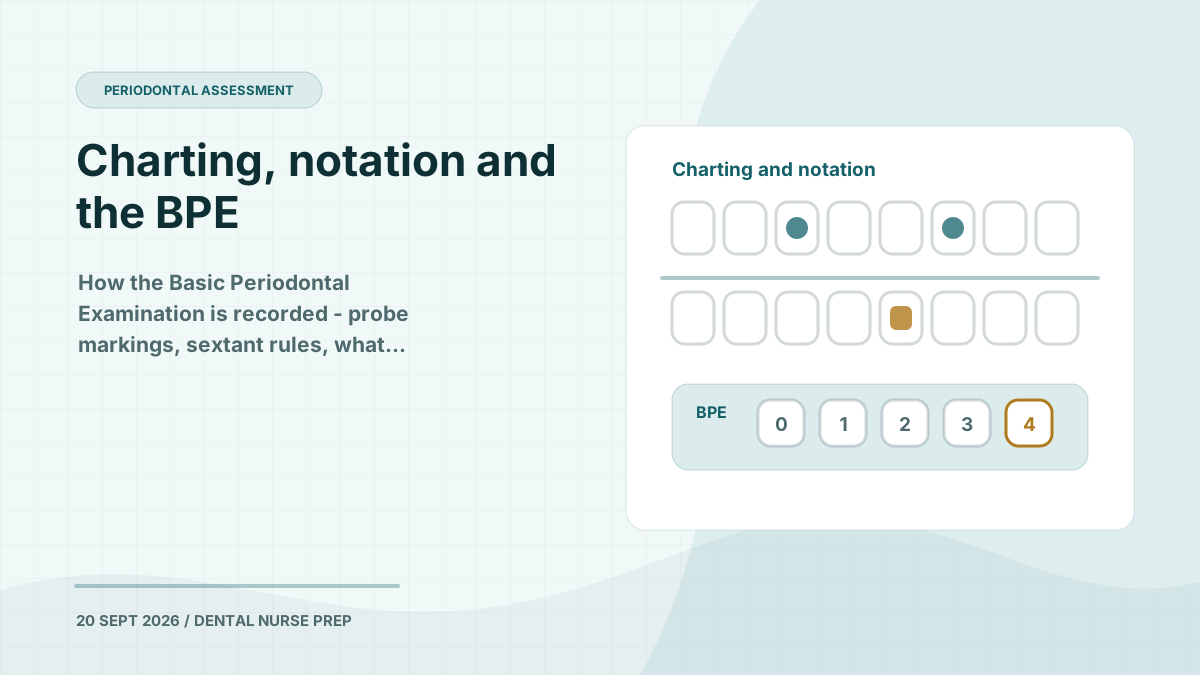
The Basic Periodontal Examination is a screening tool, and almost every mistake made with it comes from forgetting that. It does not diagnose periodontitis, it does not stage or grade anything, and it does not tell you how much bone has been lost. What it does is sort a mouth into “no further action”, “needs instruction”, “needs cleaning” or “needs a proper look” — quickly, with one instrument, in under a minute.
For the Diploma, the marks sit in three places: what the probe markings mean, what qualifies as a sextant, and what each score commits the clinician to next.
The probe
The BPE is recorded with a WHO probe — a ball-ended probe with a 0.5 mm sphere at the tip and a coloured band. The blunt tip matters: it reduces the chance of pushing through the junctional epithelium and it makes calculus detection easier by feel.
“It has a round blunt tip to minimise discomfort and prevent tissue damage during probing.”
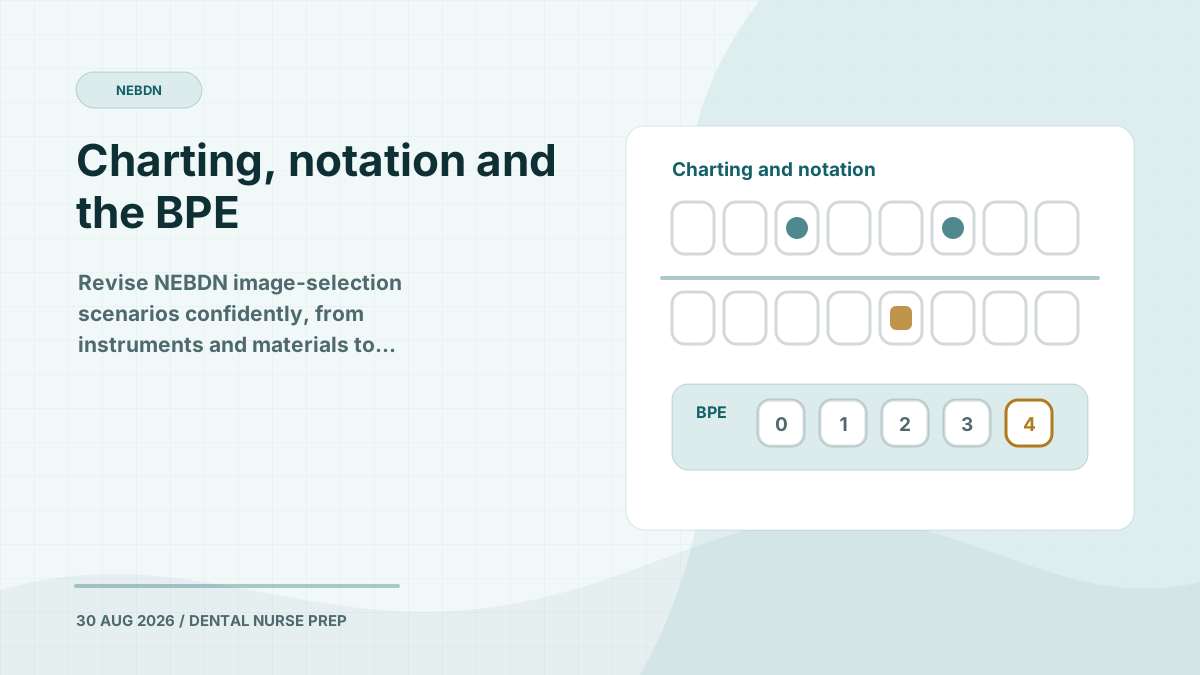
The band runs from 3.5 mm to 5.5 mm. That single feature is what makes the whole system work, because you are not reading a number off the probe — you are reading where the gingival margin sits against the band:
| What you see | Pocket depth | Score sits at |
|---|---|---|
| Band fully visible, no bleeding, no calculus | Under 3.5 mm | 0 |
| Band fully visible, bleeding on probing | Under 3.5 mm | 1 |
| Band fully visible, calculus or plaque retention factor | Under 3.5 mm | 2 |
| Gingival margin within the band | 3.5–5.5 mm | 3 |
| Band completely disappears below the margin | Over 5.5 mm | 4 |
Probing force is 20 to 25 grams. The useful calibration is pressing the probe against your own thumbnail until the nail bed blanches — that is roughly the force. Heavier probing pushes the tip through inflamed tissue and manufactures pockets that are not there.
Sextants, and the two rules that get tested
The mouth is divided into six sextants: upper right posterior, upper anterior, upper left posterior, and the same three in the lower arch. The posterior sextants run from second molar to first premolar; the anterior sextants run canine to canine.
Two rules attach to that, and exam questions like both:
- A sextant needs at least two qualifying teeth. Fewer than two and you record an X — the sextant cannot produce a valid reading. The single remaining tooth’s score is carried into the adjacent sextant.
- Third molars are excluded, unless first and second molars are missing. A partially erupted wisdom tooth with a pseudopocket behind it would give a score that reflects eruption, not disease.
Only one score is recorded per sextant, and it is always the highest found. You are not averaging anything. One code 4 site in a sextant of otherwise healthy teeth makes that sextant a 4.
Walking the probe
The probe is inserted gently into the gingival sulcus and walked around the tooth — not dipped at one point and withdrawn. The sites to cover on each tooth are mesiobuccal, mid-buccal and distobuccal, then the same three on the palatal or lingual aspect. Six surfaces per tooth, every tooth in the sextant, and you record only the worst of them.
The commonest practical error is going too fast between teeth and missing an interproximal pocket, which is precisely where periodontal attachment loss tends to show first.
What each score actually commits you to
This is the part worth learning properly, because the codes are only useful if you know what follows.
- 0 — Healthy. No pockets over 3.5 mm, no calculus, no overhangs, no bleeding. Nothing to treat. The transcript makes a good point here: patients often expect a scale and polish regardless, and there is no clinical case for scaling a healthy mouth. It is not a neutral act — it removes no calculus and disturbs tissue for nothing.
- 1 — Bleeding on probing, nothing else. That bleeding is the sign of plaque-induced gingivitis. Treatment is oral hygiene instruction: brushing technique and interdental cleaning.
- 2 — Calculus or a plaque-retention factor is present. Overhanging restorations are the classic example, and they are corrected or replaced rather than just cleaned around. Supragingival and subgingival scaling as needed, plus oral hygiene instruction.
- 3 — 3.5 to 5.5 mm. This is the one where UK practice has changed, and it is worth being precise about it (see below).
- 4 — Over 5.5 mm. Full-mouth six-point pocket charting, a course of non-surgical periodontal therapy, and consideration of referral to a specialist where the case is complex or unresponsive.
- * — Furcation involvement. Recorded as a superscript asterisk alongside the number, not instead of it. A furcation is not a code, it is a flag on a code, and it signals a site that is far harder to keep clean and more likely to need specialist input.
Where the transcript is behind current UK guidance
The video says a code 3 sextant needs a six-point pocket chart of that sextant straight away. The British Society of Periodontology BPE guidance sets out a different order for code 3: carry out initial therapy — oral hygiene instruction and supra- and subgingival instrumentation — and then record a six-point chart of that sextant only, at review, usually around three months later. The reasoning is that a good number of 3.5–5.5 mm readings are inflammatory and resolve with initial therapy, so charting first produces numbers that are about to change.
The video also mentions three-monthly recalls for code 3 patients as a blanket rule. Recall intervals in the UK are set per patient on risk, following NICE guidance on dental recall, not fixed by BPE code. The BPE informs that judgement; it does not decide it.
Neither point changes the scores themselves. They change what happens afterwards — which is exactly the sort of detail an exam question likes to hinge on. If you want the codes broken down further with the diagnostic reasoning behind each one, we’ve covered them in more depth in BPE codes explained.
In the exam. Read the stem for three things in order: pocket depth relative to 3.5 and 5.5 mm, then bleeding, then calculus or retention factors. Depth outranks everything — a 4 mm pocket with no bleeding and no calculus is still a code 3.
Your part in it
As a dental nurse you are not recording the BPE yourself, but you are the reason it gets recorded accurately: having the WHO probe on the tray, charting the scores as they are called, querying a sextant that was skipped, and knowing when an X is legitimate rather than a gap in the notes.
You are also frequently the person who reinforces the oral hygiene instruction that codes 1, 2 and 3 all depend on. That is within a dental nurse’s scope and, with the right post-registration qualification, extends further into oral health education. Nothing here authorises you to probe or to diagnose — that stays with the dentist or hygienist.
It is worth knowing how BPE sits alongside the other things being recorded in the same appointment. The charting conventions overlap with incisor classification, and the instruments involved go back through the same decontamination cycle as everything else — cleaning, disinfection and sterilisation are not interchangeable terms, and the BPE probe is a case in point.
Practise the recall
BPE questions are cheap marks once the numbers are secure, and expensive ones when 3.5 and 5.5 blur together under time pressure. The fix is repetition rather than rereading.
Dental Nurse Exam Revision covers periodontal assessment alongside the rest of the NEBDN National Diploma in Dental Nursing (Level 3) syllabus — 620 questions across 10 topics, 65 of them free, written to mirror the Knowledge Test format. It is an independent revision tool and is not endorsed by or affiliated with the NEBDN.
Nothing on this page is clinical guidance. It is revision framing for an assessment — for practice, work from current British Society of Periodontology guidance, NICE, your practice protocol and your own training and supervision.
- Periodontal assessment
- Oral health
- Dental Nurse Diploma
Frequently asked
What do the bands on a BPE probe mean?
A WHO/BPE probe has a black band running from 3.5 mm to 5.5 mm, with a 0.5 mm ball end. If the band is partly visible the pocket is under 3.5 mm, if the gingival margin sits within the band the pocket is 3.5 to 5.5 mm, and if the band disappears completely the pocket is deeper than 5.5 mm.
How many sextants are there in a BPE and which teeth count?
Six — three upper, three lower. A sextant needs at least two teeth to qualify, and third molars are excluded. A sextant with fewer than two qualifying teeth is recorded as X.
What is the difference between a BPE code 3 and a code 4?
Code 3 is a probing depth of 3.5 to 5.5 mm, where the gingival margin falls within the black band. Code 4 is deeper than 5.5 mm, where the band is entirely hidden below the gingival margin.
Does a BPE code 3 mean the whole mouth needs charting?
No. Current BSP guidance is to do initial therapy, then a six-point pocket chart of the code 3 sextant after review. A code 4 in any sextant triggers full-mouth six-point charting.
How much force should be used when probing for a BPE?
Around 20 to 25 grams — roughly the pressure needed to blanch a fingernail. More than that produces false readings and causes unnecessary discomfort.