

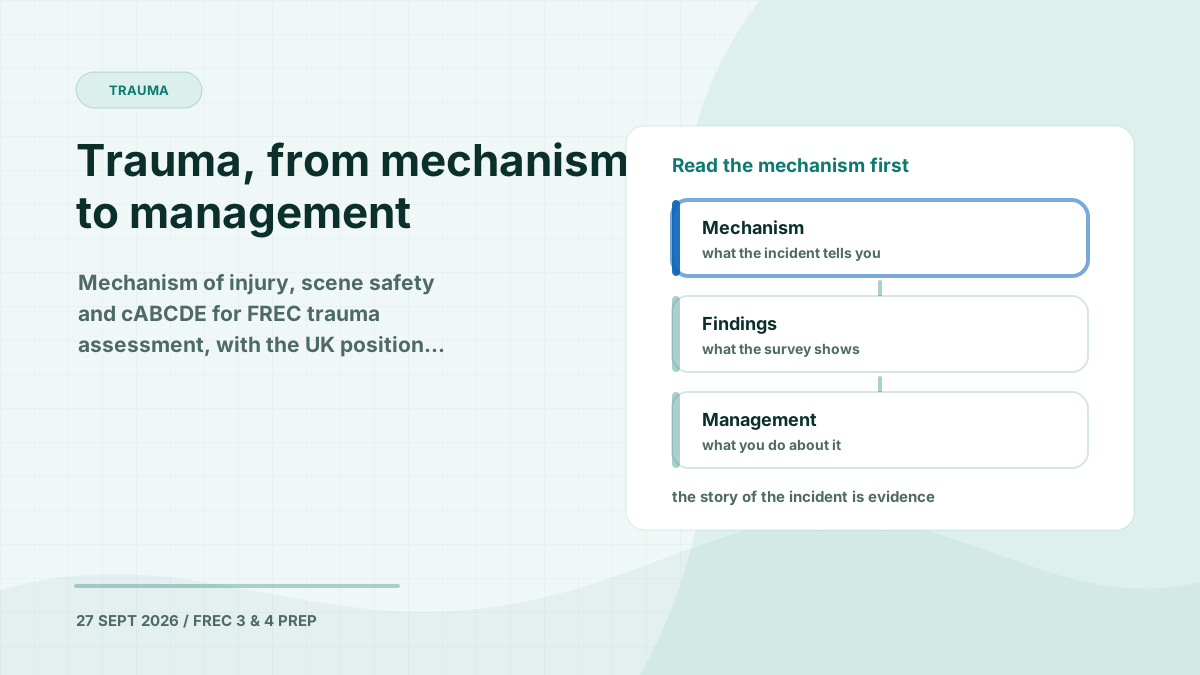
Trauma questions in FREC tend to look like they test clinical knowledge. Mostly they test order. Is the scene safe? What does the mechanism tell you? And which problem, out of everything the scenario describes, gets dealt with first?
If you have the sequence fixed in your head, most of the trauma questions become about recognising which step the scenario has reached.
Scene safety comes before the patient
Everything starts before you touch anyone. Check for traffic, fire, unstable structures, fuel, electricity, and anything else that could hurt you. A responder who becomes a casualty has doubled the workload and helped nobody.
Scene safety is not a single check on arrival. The video comes back to it at the end, and it is right to: the scene can change. Traffic builds up, a vehicle shifts, bystanders gather, a fire develops. Keep reassessing and change your approach if you need to.
Once the scene is safe, and if there is more than one patient, you prioritise. Triage is a topic in its own right, but the principle is simple. The patient making the most noise is not always the one in the most danger.
Kinetics and mechanism of injury
The kinetics of trauma is about how forces act on the body. Knowing the mechanism lets you predict injuries before you find them, so you look for them on purpose instead of stumbling on them later.
The factors worth remembering:
- Speed of impact. Higher speeds transfer more energy and usually cause more severe injuries.
- Type of collision. Frontal, side-on, rear-end and rollover collisions each produce typical injury patterns.
- Patient position. Ejection, or being in certain positions at the moment of impact, raises the risk of serious injury considerably.
In a road traffic collision, asking whether the impact was frontal or side-on points you towards particular risks, such as head injury or spinal damage. The mechanism doesn’t diagnose anything. It tells you what not to miss.
Three categories of traumatic injury
| Type | Cause | Typical consequences |
|---|---|---|
| Blunt | Impacts, falls, collisions | Fractures and internal bleeding, often with little to see on the outside |
| Penetrating | Knives, bullets, sharp objects | Internal and external bleeding; the visible wound may understate the damage |
| Blast | Explosions | A mix of blunt and penetrating injuries, sometimes together |
With blunt trauma, the absence of an obvious wound is not reassuring. With penetrating trauma, the size of the entry wound says little about what lies underneath.
The primary survey: cABCDE
The primary survey finds and treats immediate threats to life in a fixed order. In UK prehospital care it is usually written with the catastrophic haemorrhage step first, often shown as a bracketed or lower-case c:
- c: Catastrophic haemorrhage. Life-threatening external bleeding is controlled first, with direct pressure, dressings and, where trained and indicated, a tourniquet or haemostatic dressing.
- A: Airway. Look for obstruction and listen for abnormal sounds such as stridor or gurgling. In an unconscious patient, consider airway manoeuvres and, within your scope, an adjunct. Our guides to the oropharyngeal airway and the nasopharyngeal airway cover which patients tolerate each one and when to hesitate.
- B: Breathing. Look for respiratory distress, such as accessory muscle use or cyanosis. Look for chest injuries, including a flail segment. Auscultation is included where your level of training covers it.
- C: Circulation. Pulse, skin colour, temperature and capillary refill time. Keep shock from blood loss in mind.
- D: Disability. Level of consciousness, assessed in the video using AVPU: Alert, responds to Voice, responds to Pain, Unresponsive.
- E: Exposure. Expose the patient enough to find hidden injuries such as bruising or lacerations. Then cover them again to protect their dignity and prevent hypothermia.
The penetrating injury example in the video shows why the catastrophic bleeding step is first. With a stab wound, bleeding control comes before everything else. Once it is controlled, you continue through the survey and look for other injuries, because the obvious wound may not be the only one.
“Always remember that in an emergency scenario time is critical and effective communication between the team is key.”
Secondary survey and history
Only once the life threats are managed do you move to a detailed examination and a focused history, from the patient or from bystanders:
- SAMPLE: Signs and symptoms, Allergies, Medications, Past medical history, Last oral intake, Events.
- SOCRATES: a structured pain history covering site, onset, character, radiation, associations, time course, exacerbating or relieving factors, and severity.
A common exam trap is a scenario that tempts you to take a history while an airway or bleeding problem is still unresolved. The primary survey comes first.
Burns: the UK terminology
The video describes burns as first, second and third degree. That language is still widely understood, but UK clinical practice describes burns by depth: superficial, partial thickness (superficial or deep dermal) and full thickness. Know both, and expect the depth-based terms in UK material.
| Older term | UK depth terminology | Typical features |
|---|---|---|
| First degree | Superficial (epidermal) | Redness and pain, no blisters |
| Second degree | Partial thickness | Blistering, intense pain |
| Third degree | Full thickness | White, leathery or charred skin, reduced or absent sensation |
First aid for burns, in the order given:
- Remove the patient from the source of the burn, provided that is safe for you.
- Cool with cool running water for 20 minutes, starting as early as possible. This matches current UK first aid guidance. Watch for hypothermia, particularly in children and in extensive burns.
- Cover with a clean, non-adherent dressing or cling film. Lay cling film on in strips rather than wrapping it tightly around a limb.
- Monitor for shock and for airway compromise, especially with facial burns, burns in an enclosed space or extensive burns.
Shock, immobilisation and where the UK differs
The video’s shock advice is to lay the patient down, raise the legs slightly unless it may cause pain or further injury, and keep them still and warm. In trauma, that caveat matters a lot. Raising the legs can aggravate pelvic, lower limb or spinal injuries. For a trauma patient, laying them flat, keeping them warm and still, and controlling bleeding is the safer default. Follow your training and your organisation’s protocol.
On immobilisation, the video lists cervical collars, scoop stretchers, vacuum mattresses and pelvic binders. It also says to “always immobilise” during the disability phase. Two corrections to the UK picture:
- In UK frameworks, cervical spine consideration normally sits alongside the airway, with manual in-line stabilisation where it is indicated. It does not wait until D.
- Current UK prehospital practice emphasises spinal motion restriction and minimal handling rather than routine immobilisation of every patient. Collars are no longer applied automatically in many services. What you use, and when, depends on your provider’s protocol and your level of qualification.
Pelvic binders are used for suspected pelvic fractures, to reduce movement and limit internal bleeding. Whether and how you apply one depends on your training and scope.
In the exam. Read the scenario and ask two questions before you look at the options. Is the scene safe? Is there catastrophic bleeding? If the answer to either is no, work down cABCDE and find the first step the scenario hasn’t resolved. The right answer is almost always that step.
Related reading
Trauma and medical emergencies share the same structured approach. Our post on medical emergencies and structured recognition is written for dental nurses, but its point about letting a fixed order beat instinct under pressure applies just as much at the roadside.
Nothing on this page is clinical guidance. It is revision material for an assessment. In practice, work from your FREC training, your provider’s protocols and current UK guidance, and stay within your scope of practice.
Revise it with FREC 3 & 4 Exam Revision
If you are preparing for the Qualsafe Level 3 Award or Level 4 Certificate in First Response Emergency Care, FREC 3 & 4 Exam Revision has 585 questions across 8 topics, with 80 free. The questions follow the multiple choice format of the question paper, and they practise exactly this kind of step-ordering. The app is an independent revision tool. It is not affiliated with or endorsed by Qualsafe Awards.
- Trauma
- Patient assessment
- FREC
Frequently asked
What does the c in cABCDE stand for?
Catastrophic haemorrhage. Bleeding that could kill within minutes is controlled before airway, breathing and the rest, because nothing else matters if the patient bleeds out while you assess the airway.
What is the difference between the primary and secondary survey in FREC?
The primary survey (cABCDE) finds and treats immediately life-threatening problems in a fixed order. The secondary survey is a more detailed head-to-toe examination and history, using SAMPLE and SOCRATES, done once the life threats have been dealt with.
How long should a burn be cooled for?
Current UK first aid guidance is to cool a burn with cool running water for 20 minutes, ideally started as soon as possible, while watching the patient for hypothermia, especially children and anyone with extensive burns.
Should you raise the legs of a trauma patient in shock?
Be cautious. Raising the legs is sometimes taught for shock in general first aid, but in trauma it can worsen pelvic, lower limb or spinal injuries. Lay the patient flat, keep them warm and still, and follow your training and local protocol.
What do SAMPLE and SOCRATES stand for?
SAMPLE covers Signs and symptoms, Allergies, Medications, Past medical history, Last oral intake and Events leading up to the incident. SOCRATES is a pain history: Site, Onset, Character, Radiation, Associations, Time course, Exacerbating or relieving factors and Severity.