

Unit 9 is almost entirely factual recall, which makes it the cheapest unit in the Diploma to pick up marks in — and the easiest to lose them in, because the numbers are specific and there are several of them.
Here is the whole scheme, with the figures that actually get examined.
The numbers
The enhanced CPD scheme runs on a five-year cycle. Within that cycle, the hours required depend on your registered title:
| Registered title | Hours per five-year cycle |
|---|---|
| Dental nurse | 50 |
| Dental technician | 50 |
| Dental therapist | 75 |
| Dental hygienist | 75 |
| Orthodontic therapist | 75 |
| Clinical dental technician | 75 |
| Dentist | 100 |
One more number matters as much as the headline figure: at least 10 hours across any two consecutive CPD years. That requirement exists to stop everything being left to the final year.
It has a consequence worth knowing, because it gets tested directly: a single year declaring zero hours is permitted, provided the two-year minimum is still met. Two consecutive zero years are not.
The four development outcomes
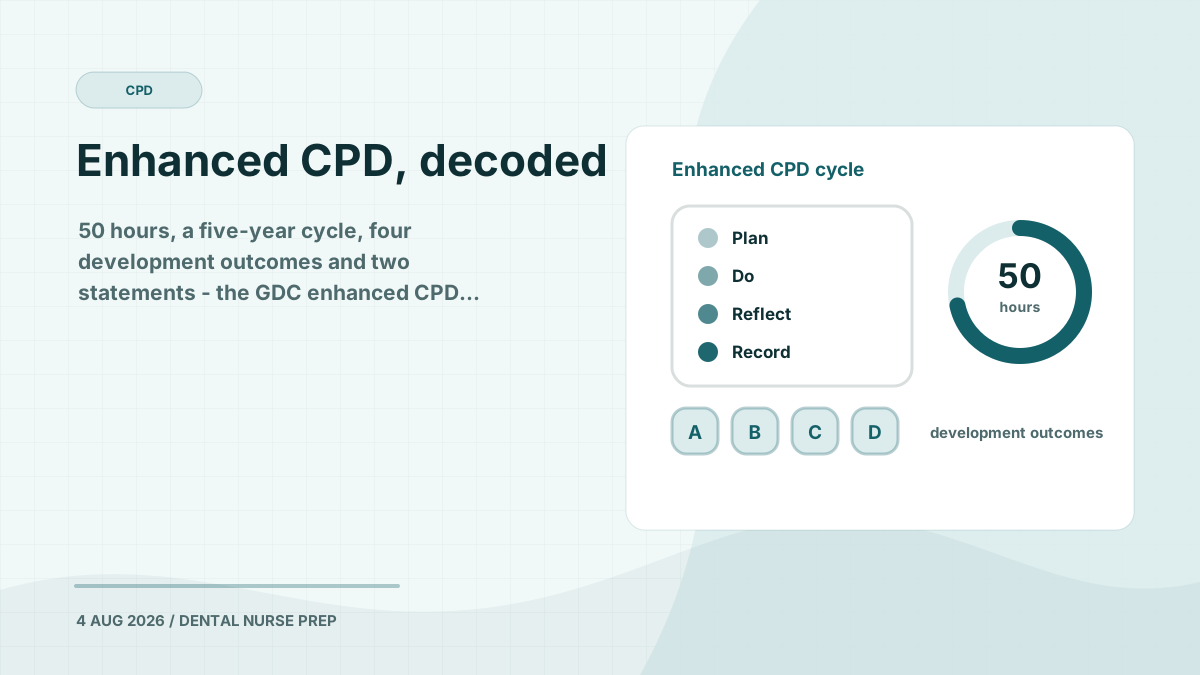
Every verifiable activity must be linked to at least one of four development outcomes, labelled A to D. An activity may map to several — being focused on one is fine, and requiring exactly one would be wrong.
| Outcome | Covers |
|---|---|
| A | Effective communication with patients, the dental team and others across dentistry |
| B | Effective management of self, and of or with others in the team, including practice and business management |
| C | Knowledge and skills within your field of practice — the technical and clinical study |
| D | Maintaining skills, behaviours and attitudes that maintain confidence in you and the profession, including ethical and legal topics |
Worked examples, because this is how the questions tend to be framed:
- A course on new decontamination equipment → C (technical study in your field of practice)
- A session on ethical and legal issues in dentistry → D
- Training on communicating with anxious patients → A
- A practice management course → B
Note that there are four development outcomes and nine principles in the Standards for the Dental Team. Those are different frameworks, and swapping the numbers is a classic distractor.
What counts as verifiable
Only verifiable CPD counts under the enhanced scheme. Verifiable activity:
- has documented aims and learning outcomes
- produces evidence of participation, typically a certificate of attendance
Two things that do not determine whether something is verifiable: the delivery format (online, in person and recorded all qualify equally), and the duration (there is no minimum). There is also no GDC list of approved providers for this purpose.
The certificate is your evidence, and you keep it — certificates are not routinely sent to the GDC, but the GDC may ask to see them.
Plan, do, reflect, record
The GDC describes CPD as a four-stage cycle: plan, do, reflect, record.
The reflect stage is the one people skim. It means reviewing the activity and considering its impact on your daily practice and on patients, then writing that reflection down. Filing the certificate and totalling the hours belong to record, not reflect — a distinction that gets examined.
The personal development plan
A PDP sets out your planned CPD for the cycle. Three things about it:
- It must be maintained across the whole cycle, not written once in year one and forgotten.
- It is adjusted as your needs change. If you take on oral health education duties partway through, that change in your field of practice should be reflected in the PDP. The cycle does not restart, and the GDC does not need to approve the change.
- The GDC may ask to see it at any point, not only at the end.
Your field of practice describes the work you actually do, so CPD can be planned around real learning needs. It is not a specialty registration and it does not alter the hours requirement, which is fixed by registered title.
What you declare, and when
Two separate submissions:
- an annual statement at the end of each CPD year, declaring the verifiable CPD completed in that year
- an end-of-cycle statement when the five years finish
Because each annual statement declares that year’s activity, CPD must be attributed to the year it was actually completed.
Your records comprise the activity log with outcomes linked to each entry, the PDP, and the evidence from each activity. They are kept for five years after the cycle ends.
It is yours. CPD is a personal registration requirement. An employer may fund it, timetable it and encourage it, but responsibility for meeting the hours, keeping records and making the declarations sits with you. Failure to comply, or to make the required statements, can lead to removal from the register — which means no longer being able to practise.
Where this sits in the Diploma
This is Unit 9, Continuing Professional Development. Its question pool is part of the app rather than the free tier, but the full study guide for the unit is free to read.
If you want to practise now, Unit 1, Professional Practice covers the neighbouring ground — registration, fitness to practise and the GDC Standards — and is free here.
Scheme rules change. Always check the current GDC enhanced CPD guidance rather than relying on a summary, including this one.
- CPD
- Registration
Frequently asked
How many CPD hours does a dental nurse need?
50 hours per five-year cycle. Dental technicians have the same requirement. Dental therapists, hygienists, orthodontic therapists and clinical dental technicians need 75 hours, and dentists 100.
What is the minimum CPD across two years?
At least 10 hours across any two consecutive CPD years. This means a single year with zero declared hours is permitted, but two consecutive zero years are not.
How long must CPD records be kept?
Five years after the end of the cycle, so the GDC can check them if needed.
Who is responsible for meeting a dental nurse's CPD requirements?
The individual registrant. CPD is a personal registration requirement — an employer may support and fund it, but responsibility for compliance cannot be transferred.