FREC 3 · Qualsafe Awards
Foundations of Prehospital Trauma Care
Mechanism of injury and blood loss, chest injuries and wounds, shock, burns and poisoning, and spinal, head and musculoskeletal injury.
The trauma component, and the largest topic in FREC 3. It opens on mechanism of injury — what the story of the incident tells you to look for before you have examined anyone — and on recognising and controlling life-threatening blood loss. It then works through chest injuries and wounds, the recognition and management of shock, burns and scalds, and poisoning, before closing on head, spinal and musculoskeletal injury and on the moving and handling that goes with them.
What this topic covers
These are the sub-topics the app's 102 questions for this topic are grouped into, with the number of questions on each. They are a fair map of where the weight sits.
| Sub-topic | Questions |
|---|---|
| Chest wounds and bleeding | 27 |
| MOI assessment and blood loss | 27 |
| Spinal MSK and moving handling | 27 |
| Shock burns and poisoning | 21 |
Study guide
The biggest topic in FREC 3, and the most scenario-driven. It is built around a single habit: read the mechanism first. A large share of the questions describe an incident and ask what to anticipate, and answering from the visible injury rather than from the mechanism is how candidates go wrong.
Mechanism of injury, assessment and blood loss
What the incident tells you, and what to do about catastrophic bleeding when it is telling you something bad.
- Mechanism of injury predicts the injuries you have not found yet. Questions describe a fall, a collision or a crush and ask what you should be looking for.
- Life-threatening external bleeding is managed before the rest of the primary assessment, and the escalation between methods of control has an order.
- Estimating blood loss by eye is unreliable, and the bank cites the evidence that it is. Expect questions where the correct answer is that the estimate cannot be trusted.
Chest injuries, wounds and bleeding
Recognition first, then management. Chest injuries are assessed on what the signs mean, not on naming the injury.
- Penetrating and blunt chest injuries present differently and are managed differently; the questions describe a presentation and expect you to work back.
- Wound types are distinguished by what caused them and what that implies for contamination, bleeding and healing.
- Dressings and the decision to escalate are examined together: knowing what to apply is half the answer, knowing when it has stopped working is the other half.
Shock, burns and poisoning
Three separate outcomes folded into one block, each recognised by its own pattern.
- Shock is recognised as a progression rather than a single set of signs, and early recognition is what the questions actually test.
- Burns are assessed on severity and on the immediate care that follows, with the layers of the skin doing the explanatory work — another reason to revise the anatomy topic alongside.
- Poisoning is examined by route of exposure, because the route determines almost everything you do next.
Spinal, head and musculoskeletal injury, and moving and handling
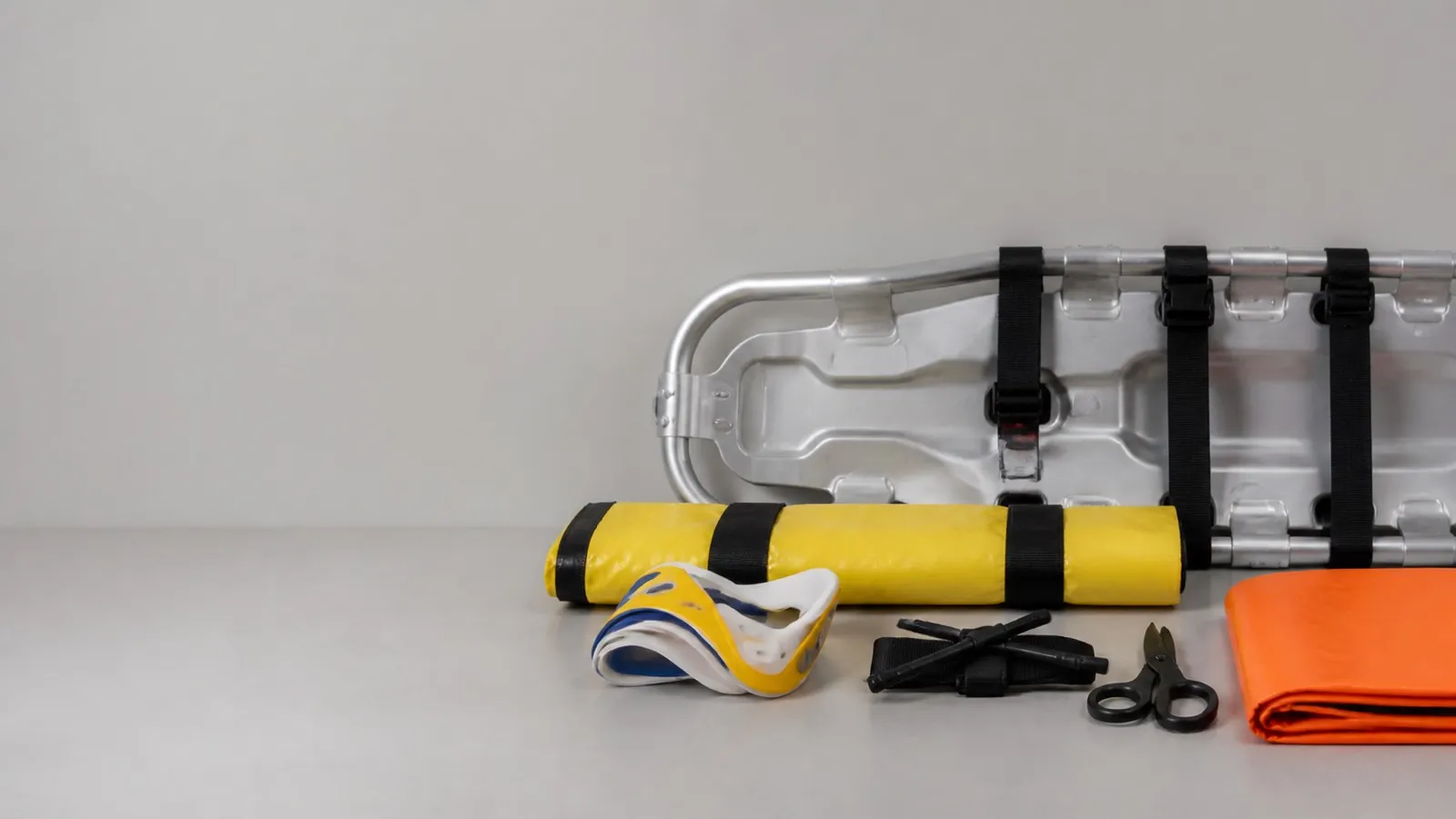
The block with the most equipment in it, and the most opportunity to make a patient worse.
- Head and spinal injury are recognised from mechanism and from changing signs over time, so questions often give you two sets of observations rather than one.
- Immobilisation and extrication decisions are judged on necessity as much as technique — moving a patient who did not need moving is a wrong answer.
- Manual handling is assessed as a risk assessment, and assisting a clinician has defined limits that come back to scope of practice.
In the exam Work backwards from mechanism. If a scenario spends a sentence describing how the incident happened, that sentence is load-bearing and at least one distractor is designed for someone who skipped it. Note also that this component is where the app deliberately carries NO eye-injury question — the source corpus could not support one, so revise that criterion from your own course material.
Practise this topic now
20 questions from this topic, free, with the explanation shown as soon as you answer. No sign-up, and nothing is recorded.
Start the Foundations of Trauma Care quizCarry on with
Foundations of Emergency Care
The responder’s role, scene safety and triage, airway assessment and management, medical gases, and resuscitation with an AED.
Foundations of Medical Care
Assessing and handing over an unwell patient, breathing difficulties and major illness, the unresponsive or convulsing patient, and environmental emergencies.
Anatomy and Physiology
The respiratory, cardiovascular, nervous and musculoskeletal systems, plus the digestive, endocrine, integumentary and reproductive systems FREC touches on.
Revise anywhere, with the whole FREC 3 & 4 bank
This site publishes the app's free sample — 80 of 585 questions, across 4 of 8 topics. FREC 3 & 4 Exam Prep carries the full bank offline across all 2 levels, so you can revise on the bus, between patients, or the night before.
- All 585 questions
- Every question across all 2 levels, including the 4 topics this site cannot unlock.
- 40-question mock test
- Timed at 60 minutes, drawn from one level at a time.
- An explanation every time
- Every answer explains itself and cites where it comes from, right or wrong.
- Progress you can see
- History and per-topic results show which levels still need the work.


For iPhone, iPad and Android.