

Dental Sedation Nursing · NEBDN
Monitoring and Equipment
Pulse oximetry, clinical observation, blood pressure, the inhalation machine, airway and oxygen equipment.
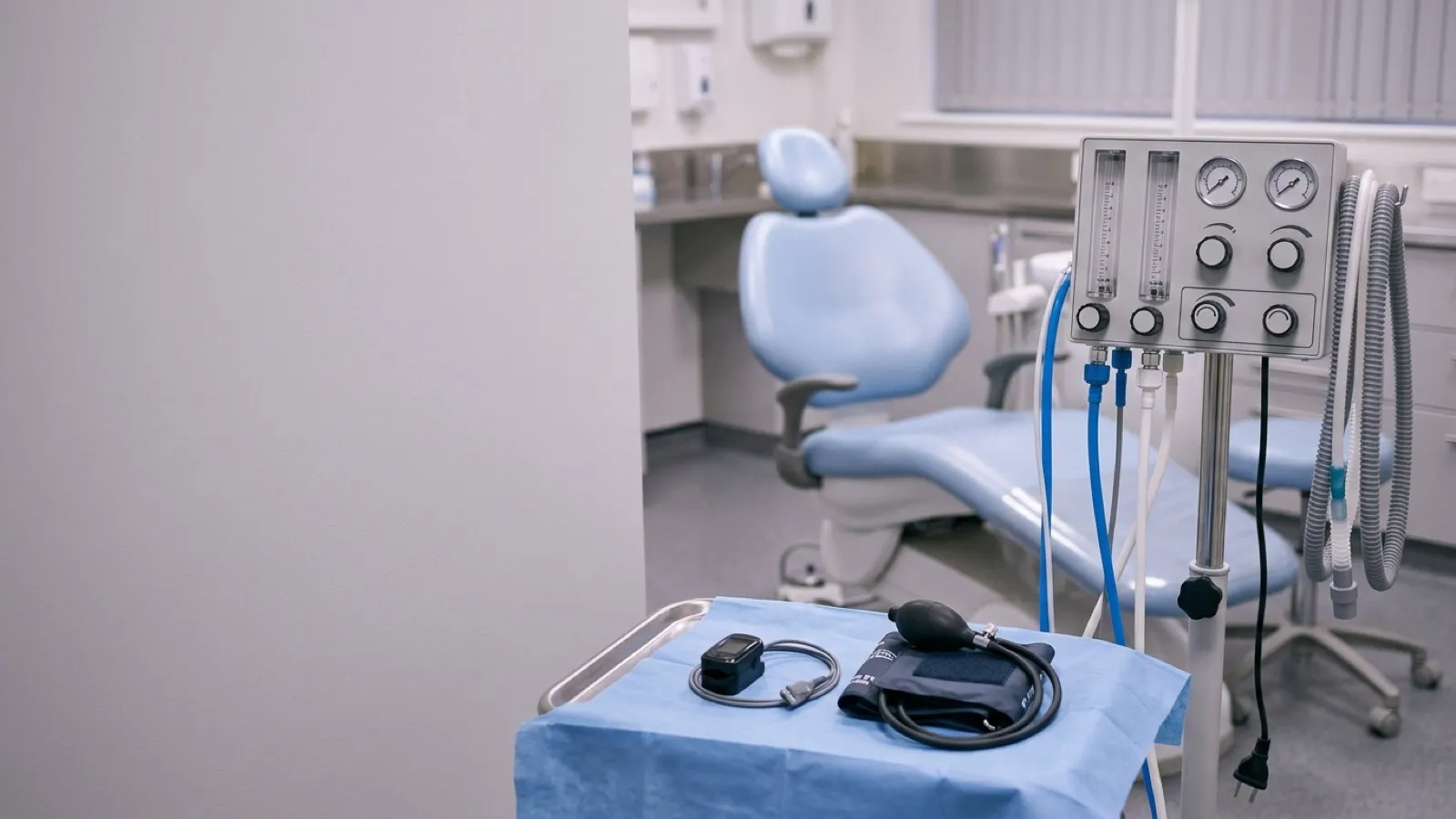
Watching the patient, and having the right thing to hand. Pulse oximetry carries the largest single block of questions in the topic, alongside clinical monitoring and direct observation, blood pressure measurement, and recognising a complication early. The equipment half covers the inhalation sedation machine and its scavenging, the chairside items required for intravenous sedation, airway and oxygen delivery equipment, and the checks and preparation that must happen before a list starts rather than during it.
What this topic covers
These are the sub-topics the app's 50 questions for this topic are grouped into, with the number of questions on each. They are a fair map of where the weight sits.
| Sub-topic | Questions |
|---|---|
| Pulse oximetry | 9 |
| Clinical monitoring and observation | 6 |
| EMQ: Airway and oxygen equipment | 5 |
| EMQ: Chairside items for intravenous sedation | 5 |
| EMQ: Inhalation sedation machine components | 5 |
| EMQ: Monitoring observations and vital signs | 5 |
| Inhalation sedation machine and scavenging | 5 |
| Equipment checks and preparation | 4 |
| Blood pressure measurement | 3 |
| Oxygen delivery | 2 |
| Recognising complications early | 1 |
Sub-topics beginning “EMQ” are extended matching questions: one stem, one right answer, and a list of up to 10 options to choose it from. They are testing whether you can discriminate between neighbouring answers, not whether you recognise the right one.
Study guide
What you watch, what you watch it with, and what must be ready before the list starts. Pulse oximetry carries the largest block of questions, and the rest divides between direct clinical observation and the equipment the surgery must have to hand.
Pulse oximetry
The single most examined item in the topic.
- A pulse oximeter measures oxygen saturation and pulse rate — knowing precisely what it does and does not measure is examinable.
- Readings can be unreliable for identifiable reasons, and questions describe those situations.
- The oximeter supplements clinical observation rather than replacing it, which is a stated principle and a question in its own right.
Clinical monitoring and observation
The nurse’s own observation, which the equipment supports.
- Level of consciousness, responsiveness, colour and breathing are observed continuously and are examined as a set.
- Blood pressure measurement has its own technique points and its own place in the sequence.
- Recognising a complication early is examined as a distinct skill from managing one.
The inhalation sedation machine
A specific machine with named components and named safety features.
- Components have defined functions and form their own extended matching set.
- Safety features exist to prevent a hypoxic mixture being delivered; know which feature prevents which failure.
- Scavenging addresses occupational exposure to nitrous oxide rather than patient safety.
Chairside items, airway and oxygen equipment
What must be present and checked, examined as lists you match against.
- Intravenous sedation requires specific chairside items to be available — the extended matching set asks you to identify them.
- Airway and oxygen delivery equipment has named components matched to their use.
- Equipment checks happen before the session; questions about "what should have been done" usually point back to this.
In the exam Pulse oximetry deserves disproportionate revision time — know what it measures, when it misleads, and why it does not replace looking at the patient. For the equipment blocks, learn the lists as matched pairs of item and purpose, since that is the form the extended matching questions take.
This topic's questions are in the app
The free tier does not unlock any of the 50 questions for this topic, so there is no quiz to run here — and publishing one anyway would give away more than the app itself does. The study guide above is free to read in full.
To practise this topic, get the app. Or start with one of the topics that are free here .


For iPhone, iPad and Android.
Carry on with
Sedation Pharmacology
Intravenous midazolam, inhalation sedation with nitrous oxide and oxygen, oral and transmucosal routes.
Assessment and Selection
ASA classification, medical history and red flags, anxiety assessment, consent, capacity and instructions.
Recovery and Discharge
Recovery management and positioning, complications, the escort, discharge criteria and who authorises it.
Revise anywhere, with the whole Post-Reg Mastery bank
This site publishes the app's free sample — 72 of 1160 questions, across 6 of 26 topics. Dental Post-Reg Mastery carries the full bank offline across all 6 certificates, so you can revise on the bus, between patients, or the night before.
- All 1160 questions
- Every question across all 6 certificates, including the 20 topics this site cannot unlock.
- 75-question mock test
- Timed at 90 minutes, drawn from one certificate at a time.
- An explanation every time
- Every answer explains itself and cites where it comes from, right or wrong.
- Progress you can see
- History and per-topic results show which certificates still need the work.
For iPhone, iPad and Android.