Dental Implant Nursing · NEBDN
Chairside, Surgical Support and Instruments
Implant components, instruments and decontamination, surgical support, grafts and membranes, torque and the restorative visit.
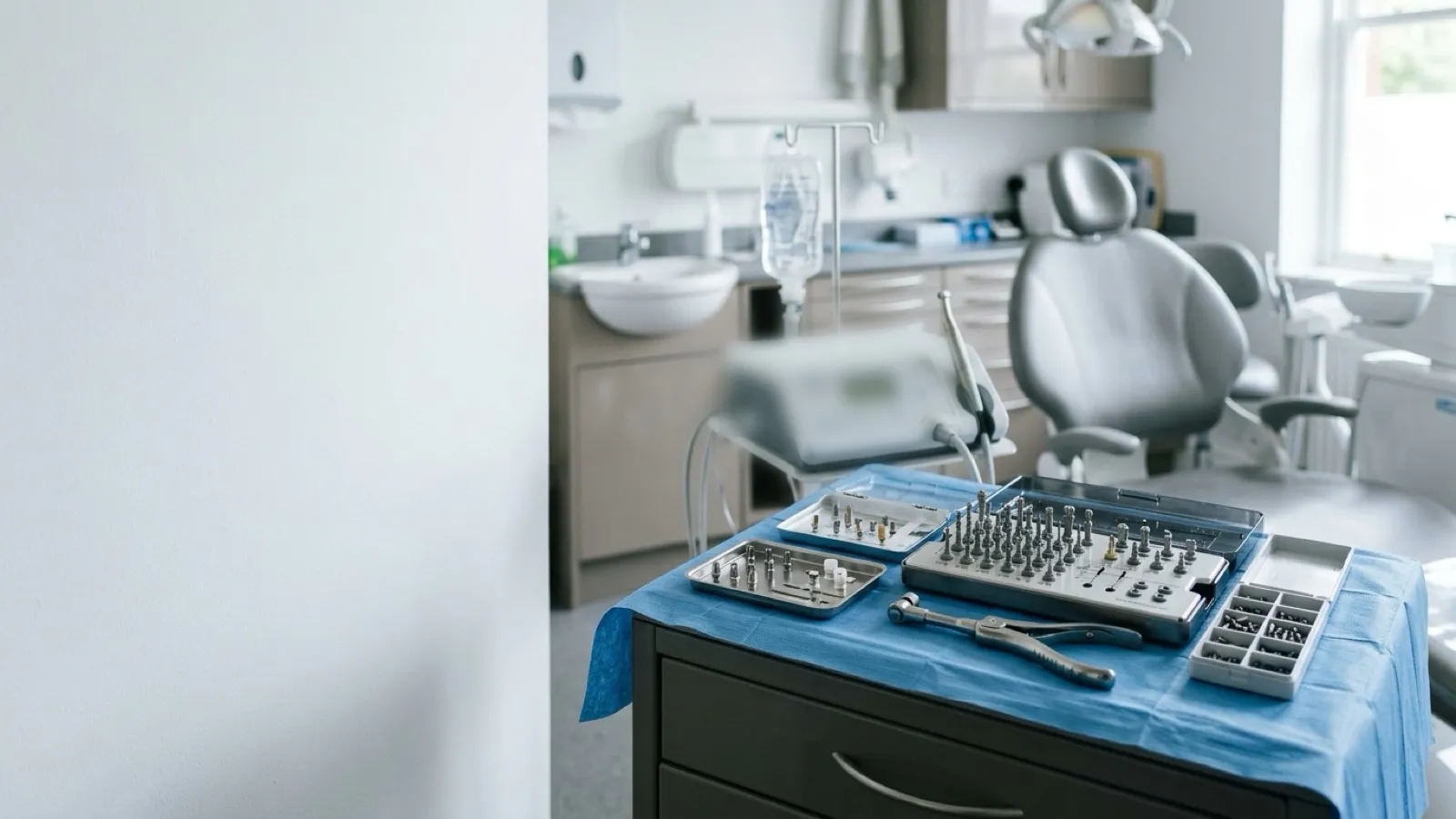
The nurse’s own job, appointment by appointment. The topic covers preparing the clinical environment and supporting the patient, surgical support, the operating field and access, and the instruments and equipment together with their decontamination. It then covers the advanced procedures — grafts and membranes — impressions, trays and materials handling, and torque, screws and the restorative appointment, and it carries its own block on medical emergencies at an implant appointment. Four extended matching blocks pair implant components with their function, chairside materials with their use, and events with the nurse’s immediate response.
What this topic covers
These are the sub-topics the app's 45 questions for this topic are grouped into, with the number of questions on each. They are a fair map of where the weight sits.
| Sub-topic | Questions |
|---|---|
| EMQ: Implant components and their function | 7 |
| EMQ: Chairside materials and their use | 6 |
| Instruments, equipment and their decontamination | 6 |
| EMQ: Events and the nurse's immediate response | 5 |
| Advanced surgical procedures, grafts and membranes | 4 |
| Preparing the clinical environment and supporting the patient | 4 |
| Torque, screws and the restorative appointment | 4 |
| Impressions, trays and materials handling | 3 |
| Medical emergencies at an implant appointment | 3 |
| Surgical support, the operating field and access | 3 |
Sub-topics beginning “EMQ” are extended matching questions: one stem, one right answer, and a list of up to 10 options to choose it from. They are testing whether you can discriminate between neighbouring answers, not whether you recognise the right one.
Study guide
The nurse’s own topic — what you prepare, hand over, hold, handle and do when something happens. It is also the most component-heavy part of the certificate, and the components are tested by description rather than by name, so a vocabulary list learned in the wrong direction will not answer the questions.
Preparing the environment and supporting the patient
The work before the operator sits down, some of which the GDC describes explicitly.
- The GDC describes tasks dental nurses generally carry out, and a question may ask whether a described task is among them.
- Surgical suction and irrigation have stated purposes during placement, and the purposes are not the ones assumed from ordinary chairside suction.
- The implant text gives a reason for completing the procedure promptly once the flap is raised, and that reason is examinable.
Instruments, drills and decontamination
A block where the sequence and the handling rules are both specific.
- Drills are handed over in sequence, and the drill that finishes the preparation carries its own stated significance.
- Instruments laid out and never used are still treated as used for decontamination purposes — a rule that catches people out.
- Aspirating equipment has its own required protections in the guidance.
Components and materials
Two extended matching sets, and the densest vocabulary in the certificate.
- Fixture, abutment, cover screw, healing abutment, impression coping, analogue and the rest are all matched from descriptions of what they do.
- Chairside materials are matched the same way — membranes, graft materials, sutures, cements — so learn each by its function.
- Grafts and membranes carry their own content: what a barrier is there to do, what resorbable materials require, and what the alternatives to the patient’s own tissue are.
Impressions, torque and the restorative visit
The second half of the treatment, where the numbers live.
- Open and closed impression techniques differ, and divergent implant angulations decide which is used.
- A digital scan requires something fitted first, which is a straightforward mark if you know it.
- Torque values are stated for the abutment screw and handled differently for driving the fixture itself; the amount of cement needed for a cemented crown is also stated, and excess cement is a peri-implantitis risk rather than an aesthetic one.
When something happens
Medical emergencies and the immediate response, including a full extended matching set.
- The emergency drug store is governed by current resuscitation guidance rather than by what an implant practice thinks it needs.
- A collapse part-way through a placement raises a specific question about the state of the site, and the GDC places the nurse somewhere specific in what follows.
- The extended matching set asks for the nurse’s single immediate response to an event — first action, not eventual management, and the distractors are all things that happen later.
In the exam Build the component and material lists as description-to-name pairs from the start; every one of the three big matching sets runs that way. For the emergency set, answer with the immediate response — the most common error is selecting a correct action that belongs three steps further on.
This topic's questions are in the app
The free tier does not unlock any of the 45 questions for this topic, so there is no quiz to run here — and publishing one anyway would give away more than the app itself does. The study guide above is free to read in full.
To practise this topic, get the app. Or start with one of the topics that are free here .


For iPhone, iPad and Android.
Carry on with
Anatomy and Osseointegration
Jaw anatomy and the structures that constrain placement, bone quality, osseointegration, and peri-implant disease.
Assessment and Planning
The planning pathway, medical history, imaging and records, timing and loading protocols, and the implant team.
Health, Safety and Practice
Clinical governance and risk, infection control, records and information governance, evidence and audit, scope of practice.
Revise anywhere, with the whole Post-Reg Mastery bank
This site publishes the app's free sample — 72 of 1160 questions, across 6 of 26 topics. Dental Post-Reg Mastery carries the full bank offline across all 6 certificates, so you can revise on the bus, between patients, or the night before.
- All 1160 questions
- Every question across all 6 certificates, including the 20 topics this site cannot unlock.
- 75-question mock test
- Timed at 90 minutes, drawn from one certificate at a time.
- An explanation every time
- Every answer explains itself and cites where it comes from, right or wrong.
- Progress you can see
- History and per-topic results show which certificates still need the work.
For iPhone, iPad and Android.